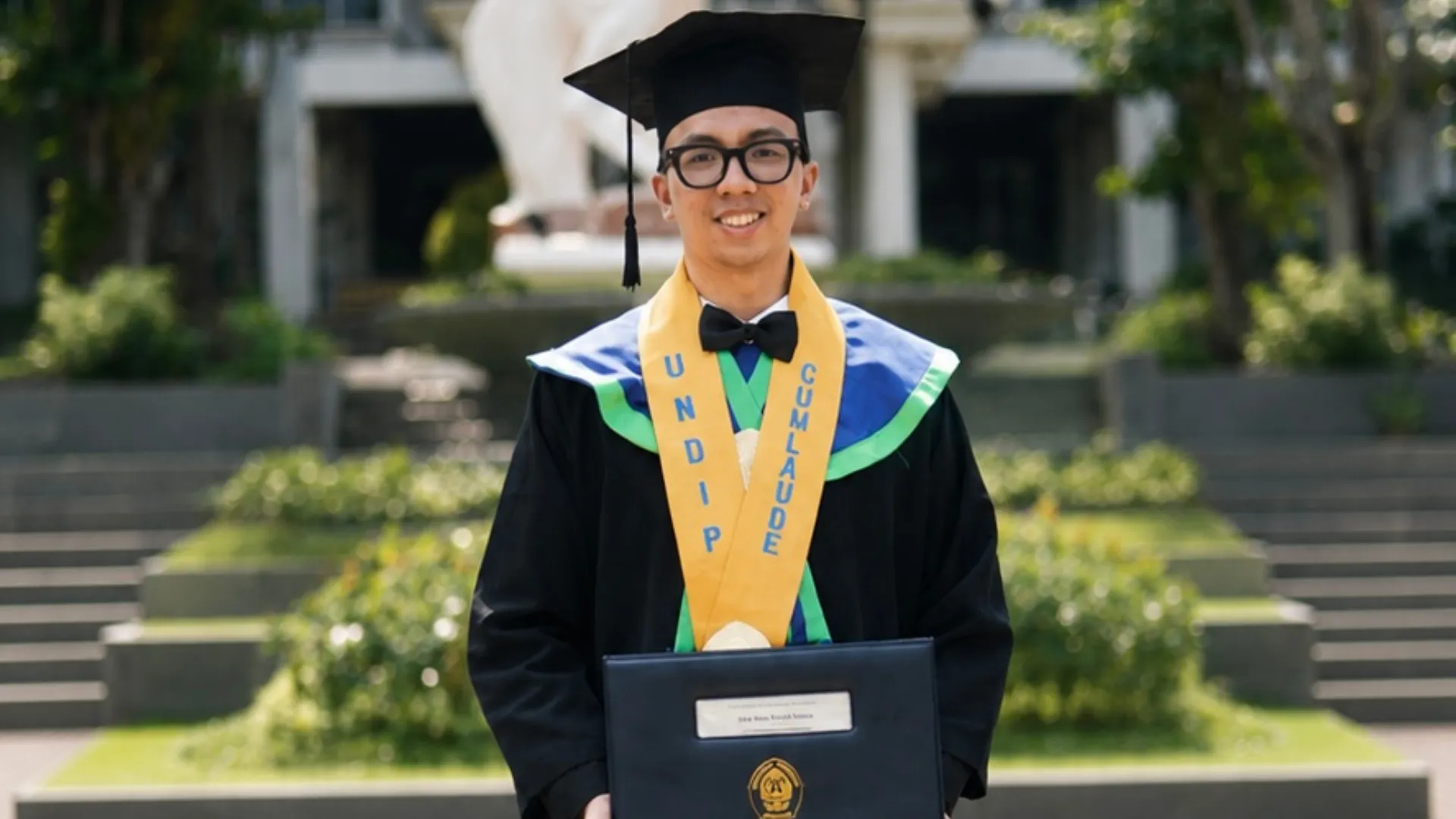
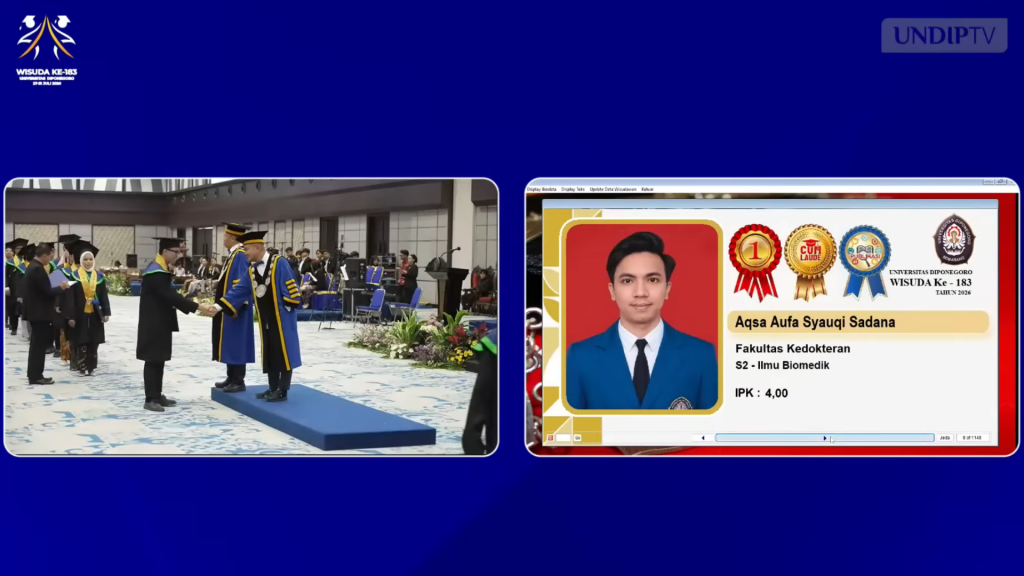
SEMARANG – Aqsa Aufa Syauqi Sadana, S.Ked., M.Biomed., the best graduate of the Master’s Program in Biomedical Sciences at the Faculty of Medicine, Universitas Diponegoro (FK Undip), has proven that age is no barrier to producing high-quality research with global impact. Graduating through the Degree by Research (DBR) program at the age of 22 with a perfect Grade Point Average (GPA) of 4.00, Aqsa was also recognized as the best graduate at the FK Undip Physician Oath Ceremony held on July 28, 2026, alongside 107 other newly qualified healthcare professionals. In addition, he received the Best Publication Award and the 2025 DPD Award in recognition of his contributions to biomedical research and the development of healthcare technologies rooted in local wisdom.
For Aqsa, these accolades represent more than academic recognition—they are a responsibility to continue contributing through meaningful research.
“Alhamdulillah, I am deeply grateful for all these achievements. For me, awards are not the ultimate goal but rather a responsibility and motivation to keep growing. Becoming the best graduate of the Master’s Program in Biomedical Sciences at FK Undip with a perfect 4.00 GPA and receiving the Best Publication Award are the results of a dedicated process and the extraordinary guidance of my supervisors and researchers at BRIN,” he said.
He added that receiving the 2025 DPD Award further strengthened his belief that research should create tangible benefits for society. In his view, the success of a researcher should not be measured solely by the number of publications or awards, but by the real impact of their work in improving people’s quality of life.
Aqsa’s success in completing his master’s degree through the Degree by Research (DBR) scheme within a relatively short period was made possible by his disciplined approach to managing every stage of the research process. He consistently set weekly and monthly targets covering proposal development, data collection, laboratory analysis, statistical analysis, and manuscript preparation.
Beyond effective time management, Aqsa believes that collaboration was a key factor behind the success of his research. The guidance of his academic supervisors, the support of researchers at the National Research and Innovation Agency (BRIN), as well as encouragement from his family and fellow researchers, provided a strong foundation that enabled each stage of the research to progress smoothly.
Aqsa’s research formed part of the SIMCEH 2019–2024 flagship research project, which investigated the interaction between genetic variations and environmental exposure, particularly mercury exposure among pregnant women. His findings revealed that mercury exposure was associated with an increased risk of obstetric complications, while variations in the GSTP1 gene suggested that individuals respond differently to environmental exposure based on their genetic profile.
The study is expected to provide an evidence-based foundation for developing preventive strategies and improving maternal and child healthcare services, while also strengthening research on the interplay between genetic and environmental factors in reproductive health in Indonesia.
The quality of this research led to the publication of Aqsa’s manuscript in a prestigious Scopus Q1 international journal. According to him, publishing in a high-impact journal was not an overnight achievement but the result of a rigorous process involving extensive feedback and multiple rounds of revisions from peer reviewers.
“I believe that publishing in a Scopus Q1 international journal is determined more by perseverance in improving the quality of the manuscript than by simply pursuing publication itself. It required extensive feedback and numerous revisions based on reviewers’ comments,” he said.
Beyond his academic pursuits, Aqsa founded the AQSA Center as a collaborative platform for research and innovation aimed at empowering young generations. Through this initiative, he hopes to encourage more school students, university students, academics, and members of the public to engage in research that generates practical solutions to national challenges.
He believes that research becomes truly meaningful when its outcomes can be translated into real-world applications. Therefore, innovation should not end with scientific publication but should be transformed into technologies and practical solutions that benefit society.
Looking ahead, Aqsa hopes to pursue further education, expand research collaborations at both the national and international levels, and produce studies that drive innovation, advance healthcare technologies, and support evidence-based policymaking to improve public health.
To young Indonesians aspiring to become researchers, Aqsa encouraged them to take the first step without hesitation and to remain committed to lifelong learning.
“Never be afraid to begin conducting research, even if it starts with something simple. Keep learning, remain open to constructive criticism, and build meaningful collaborations. Achievement is not the result of working alone, but of growing together with others. Let research become a pathway to creating benefits for society, not merely a means of earning recognition,” he concluded. (FK Undip Public Relations)